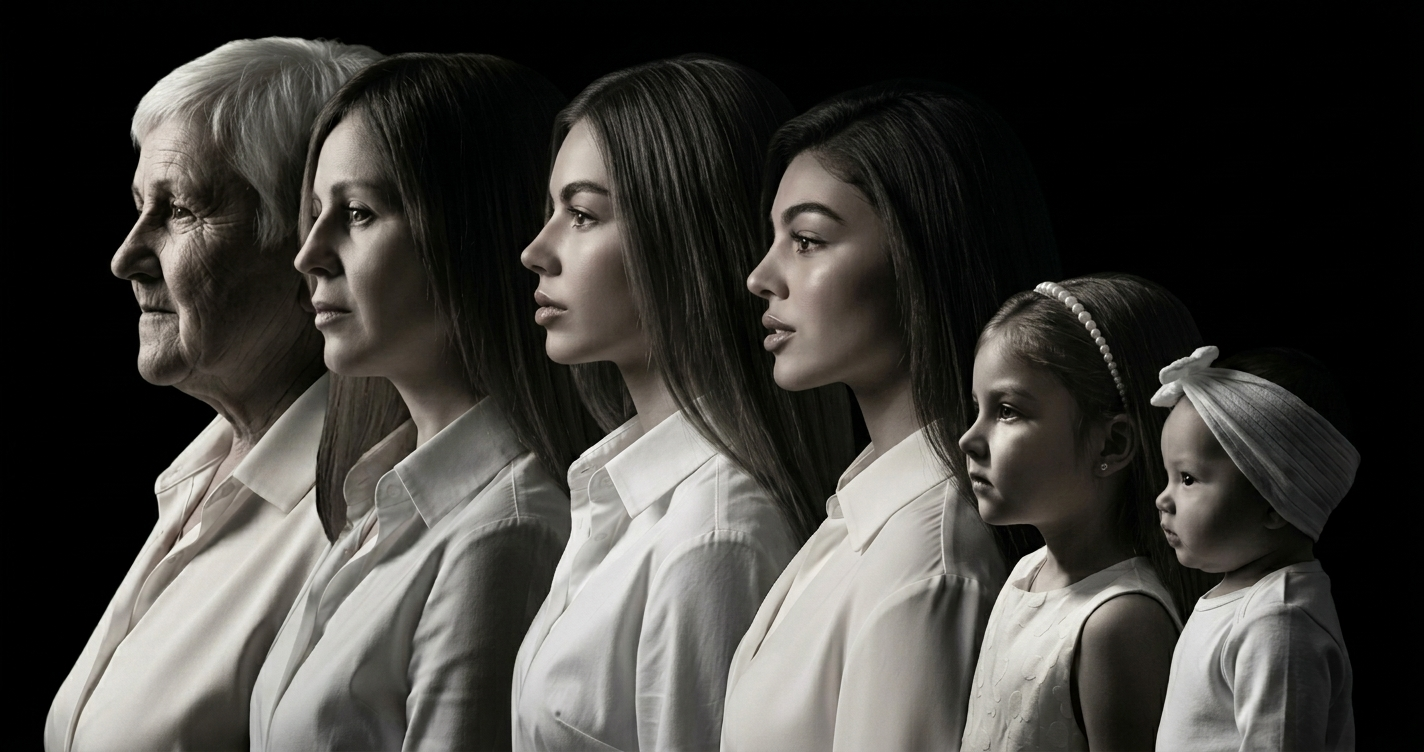
It happened in an ordinary moment. Maybe you were tired, or stressed, or running out of patience with your child over something small. You opened your mouth and heard it: your mother's voice. Your father's words. The exact tone you swore, years ago, you would never use.
You stopped. Something cold moved through you. Not because the words were terrible, but because they were familiar. Because you recognized them not as something you chose, but as something that had been living inside you, waiting.
If you have ever caught yourself repeating a pattern from your childhood and felt that disorienting mix of shame and recognition, you are not alone. And you are not broken. You are standing at the edge of something most people never even notice: the invisible inheritance, the generational patterns handed to you so quietly that you mistook them for normal.
This is what breaking generational trauma actually begins with. Not a dramatic awakening. Not a therapy breakthrough. Just a small, startled moment where you realize: that was not my voice. That was a pattern I was given.
What the invisible inheritance is
Every family passes things down. Recipes, traditions, stories. But families also pass down things no one talks about: the way conflict is handled, the way love is expressed (or withheld), the way emotions are treated, the things that are never said out loud.
Generational trauma is not always a dramatic event echoing through the decades. More often, it is a quiet set of patterns: the way your parents related to each other, the way they responded to your feelings, the rules you absorbed about what was acceptable and what was not. These patterns repeat not because anyone chooses them, but because they were learned so early and so deeply that they feel like instinct.
Normal is just whatever you grew up inside.
That is what makes generational patterns so hard to see. They do not feel like patterns. They feel like facts about how life works. The child who was told "stop crying" grows up believing that emotions are a disruption. The child whose love was conditional grows up chasing approval without knowing why. The child who watched their parents avoid conflict grows up terrified of disagreement.
None of these were lessons written on a chalkboard. They were absorbed through thousands of small moments across years of childhood, so woven into the fabric of daily life that questioning them would feel like questioning gravity.
That is the invisible inheritance: the patterns handed to you so quietly that you never thought to question them. Not because you were careless, but because the best hiding place for a pattern is inside the word "normal."
How generational patterns actually pass down
Understanding how these patterns travel from one generation to the next can make the invisible feel a little more visible. And the answer is simpler, and more human, than most people expect.
Generational patterns pass down through relationships. Through the way caregivers respond to a child's needs, emotions, and bids for connection. Through what is modeled in moments of stress, conflict, joy, and vulnerability. Children are extraordinary observers. Long before they can name what they are seeing, they are absorbing it: the tone, the silence, the look on a parent's face when certain topics come up.
Attachment research, built across decades of study, shows that the way a caregiver consistently responds to a child's emotional needs shapes that child's internal working model of relationships. If your tears were met with comfort, you learned that your emotions were safe and welcome. If your tears were met with "toughen up" or cold silence, you learned something very different. That internal model travels with you into adulthood, into your friendships, your partnerships, and eventually into the way you parent your own children.
A parent who was never allowed to cry will struggle to hold space for a child's tears. Not out of cruelty, but because they were never shown what that looks like. A parent who earned love through performance will, without meaning to, tie their child's worth to achievement. A parent who grew up in a home where conflict meant danger will either avoid disagreements entirely or handle them the only way they know: loudly, or with punishing silence.
The pattern does not need intention to travel. It only needs a relationship.
You do not pass down what you intend to. You pass down what you have not yet examined.
You may have heard the idea that trauma can be inherited biologically, through changes in gene expression sometimes called epigenetics. This is an active area of scientific research, and some animal studies have produced suggestive findings. In humans, however, the evidence remains limited and difficult to separate from the powerful effects of environment and learned behavior. Epigenetic inheritance of trauma in humans is a promising theory, not a proven fact. The well-established, clinically accepted mechanism is relational: trauma shapes the parent, the parent shapes the child, and the cycle continues until someone notices it and decides to do something different.
The patterns hiding in plain sight
Here is where this stops being abstract. If you grew up in a family, you grew up inside patterns. Some of them served you. Some of them quietly shaped you in ways you are only beginning to recognize.
These are some of the most common signs of generational trauma, the toxic family patterns that hide in plain sight because they feel so familiar.
Love shown only through provision
Your parent worked long hours, made sure you had food, clothes, a roof. And you knew, somewhere, that this was their way of loving you. But you cannot remember the last time they said the words out loud. Warmth was replaced by duty. Affection was replaced by sacrifice. You grew up grateful but quietly hungry for something you could not name.
Worth tied to performance
Good grades earned praise. Awards earned attention. Anything less earned silence, or worse, disappointment. You learned early that approval had to be earned, that love was the reward for being good enough, and that rest or mediocrity meant you were failing. So you kept performing, long past the point where the audience was anyone other than the voice in your own head.
Feelings dismissed or silenced
"Stop crying." "You are fine." "Do not be so sensitive." These were not said with cruelty, usually. They were said by people who had been told the exact same thing when they were small. And so a child learned that their feelings were a problem, not a signal. They learned to swallow what they felt, to manage the discomfort of others by hiding their own. If you recognize this, you may also recognize the emotions you were taught to swallow and the quiet cost of holding them in for years.
Conflict handled through silence or explosions
In some families, disagreement meant the silent treatment: days of cold distance, withdrawal of affection, a house that felt like a held breath. In other families, it meant eruption: raised voices, thrown words, the kind of anger that filled every room. In neither case did anyone sit down, talk through what happened, and repair the rupture. So the child learned that conflict is either dangerous or unbearable, and never learned that it could be something two people walk through together and come out closer on the other side.
Parents who could never apologize
The adult was always right, not because they were, but because being older meant never having to say sorry. A child who never receives an apology from the people who matter most learns something devastating: that authority means never being accountable, and that their own hurt does not deserve acknowledgment.
Comparison used as motivation
"Why can't you be more like your sister?" "Your cousin got into that school, why can't you?" The intention was motivation. The result was a child who learned that they were never quite enough on their own. That their worth was always relative, always measured against someone else. That love had a leaderboard.
Guilt and obligation as control
"After everything I have done for you." This sentence, said to a child, wraps love and debt together until they cannot be separated. The child learns that receiving care creates a ledger, that they owe something for being loved, and that saying no to a parent is a form of betrayal.
Image over honesty
What happened at home stayed at home. The family's reputation mattered more than any one person's pain. A child who grows up inside this rule learns that appearances are more important than truth, that asking for help is a form of disloyalty, and that their own suffering is less important than how the family looks to the outside world.
Affection withdrawn as punishment
When a child misbehaved, the consequence was not a conversation. It was distance. Love was pulled back like a tide, and the child was left standing in the cold until they corrected their behavior. This teaches a child that love is conditional, that connection can be taken away at any time, and that the safest strategy is to never make mistakes.
Rest treated as laziness
If you grew up in a home where sitting down meant you were not trying hard enough, where idle hands were always wrong, where productivity was the only proof of value, you may still carry that. You may still feel a low hum of guilt whenever you stop moving. The pattern says: your worth is what you produce. And it was handed to you by someone who was taught the very same thing.
Roles assigned too early
The responsible one. The peacemaker. The invisible one. Some children were given adult-sized roles before they had adult-sized shoulders. They became the mediator between fighting parents, the caretaker of younger siblings, the one who kept the household running. If this was you, if you were the child who grew up too fast, you may still struggle to let someone else take care of you, because you were never allowed to learn how.
Toughness over tenderness
In many families, across many cultures, vulnerability was treated as weakness. Crying was corrected. Sensitivity was shamed. Strength meant endurance, and endurance meant silence. For the boys who were told not to cry, the cost has been adding up for a lifetime. But this pattern is not only about boys. It is about any child who learned that being strong meant not feeling, and carried that lesson into adulthood as though it were truth.
These patterns cross cultures, class, and geography. They are not the product of any one country or tradition. They are human. They show up in families that look perfect from the outside and in families that wear their pain openly. The common thread is invisibility: the patterns were never named, so they were never questioned.
Why this is not about blame
Here is the part that matters as much as any pattern on the list above.
The parents who passed these patterns to you were not villains. Most of them were people who were raised inside the same patterns, by parents who were raised inside them before that. The cycle was not started by any single person. It was built over generations, shaped by cultures, economies, wars, migrations, and the simple human tendency to raise children the way you were raised, because it is the only thing you know.
Your parents did not give you what they chose to withhold. They gave you what they had.
Many of them genuinely believed they were loving you. Some of them were. The parent who pushed you to achieve believed they were preparing you for a hard world. The parent who told you to stop crying believed they were teaching you resilience. The parent who never apologized may have never received an apology themselves, and so the concept simply did not exist in their emotional vocabulary.
Understanding where a pattern came from is not the same as excusing the harm it caused. You can hold both truths at the same time: that your parents did the best they could with what they had, and that what they had was not enough. Neither truth cancels the other.
This is not about building a case against your family. It is about seeing the pattern clearly enough to stop carrying it forward.
The cost of not noticing
Unexamined patterns do not stay still. They grow. They shape the way you love, the way you fight, the way you parent, the way you treat yourself when no one is watching.
The adult who learned that love is conditional may spend their life performing for affection they already deserve. The adult who was taught that emotions are a burden may build a life that looks successful but feels hollow, because they cut off the very feelings that make a life feel real. The adult who never saw healthy conflict may avoid every hard conversation until the distance between them and the people they love becomes the whole relationship.
And then, the cruelest part: the patterns you do not see are the ones most likely to reach your children. Not because you are a bad parent, but because the invisible stays invisible until someone turns on the light.
The child who watches you push through exhaustion learns that rest is weakness. The child who never sees you cry learns that feelings should be hidden. The child who watches you apologize, or never watches you apologize, builds their own model of what accountability looks like.
They are not listening to your advice. They are watching your patterns.
This is not written to make you feel guilty. It is written because the moment you see the pattern is the moment it loses some of its power. And that moment, uncomfortable as it is, is the beginning of something different.
Becoming a cycle breaker
Breaking generational trauma is not a single decision. It is a practice. It is something you do in small moments, over and over, often imperfectly, sometimes while feeling completely alone.
Here is what the work actually looks like.
Name the pattern. You cannot change what you cannot see. Start by noticing the moments when you react instead of respond, when something your child does triggers a feeling in you that is bigger than the moment warrants. That disproportionate reaction is often the voice of a pattern, not the voice of the present. Name it, even if only to yourself: "That was the pattern talking."
Feel the grief. When you see a pattern clearly for the first time, there is often a wave of sadness underneath it. Not just for your children, but for yourself. For the child you were, who did not get what they needed. That grief is not weakness. It is the natural response to recognizing a loss you have been carrying without knowing it. Let it be there. Do not rush past it to get to the "fixing" part.
Choose a different response. This is the hardest and most ordinary part. It means pausing before you react. It means sitting with your child's tears instead of telling them to stop. It means repairing after you raise your voice, instead of pretending it did not happen. It means saying "I am sorry" even when no one modeled that for you. These are small choices. They do not feel heroic. But each one interrupts a pattern that may have been running for decades.
Accept the loneliness. Being the one who changes things in a family can feel isolating. The people around you may not understand why you parent differently, why you set boundaries, why you refuse to use guilt or silence as tools. Some of them may see your choices as a criticism of how they raised you. That is their pattern talking. Your job is not to convince them. Your job is to keep choosing differently, even when it is lonely.
Know that small shifts count. You do not need to reinvent yourself. You do not need to be a perfect parent or a perfect person. You just need to be a little more aware than the generation before you, and a little more willing to do the uncomfortable thing. That is enough. Over time, small shifts become a new normal, and that new normal is what your children will inherit.
A cycle breaker is not someone who does everything right. It is someone who refuses to pretend that the pattern is not there.
When to reach for support
Some patterns can be recognized and gently shifted on your own, through awareness, journaling, conversations with a trusted person, or the simple willingness to keep noticing.
But some patterns run deeper than awareness alone can reach. If you find that certain emotional reactions feel overwhelming, automatic, or tied to experiences from your childhood that still carry pain, working with a therapist who understands family systems and intergenerational patterns can provide the safety and pacing that deeper work often requires.
Reaching for support is not a sign that you have failed at breaking the cycle. It may be the most direct way to break it. For someone who grew up in a family where asking for help was not allowed, the act of reaching out is itself a break in the pattern.
You do not have to do this alone. In fact, doing it alone can sometimes reinforce the very pattern you are trying to change: the belief that you must handle everything yourself, that needing support means something is wrong with you.
The invisible inheritance, revisited
You did not choose what was handed to you. The patterns were already in motion before you were born, woven into the way your family loved, fought, stayed silent, and held on. You inherited them the way you inherited the shape of your face: without permission, without awareness, without a say.
But here is what you do get to choose: what you carry forward.
The invisible inheritance does not have to stay invisible. The moment you see a pattern, truly see it, it starts to loosen. It does not disappear overnight. It does not dissolve in a single therapy session or a single conversation. But it weakens every time you notice it, name it, and choose something different.
Every parent who pauses before reacting, every adult who apologizes when they get it wrong, every person who allows their child to feel what they were never allowed to feel, is rewriting something that was written long before they were born.
That is not small. That is generational.
You did not choose what you inherited. But you get to choose what you pass on.
About Worthy Steps
Worthy Steps was founded by a licensed professional therapist with deep expertise in child development, special education, and family counseling. Our mission is to support child wellbeing and help families break cycles of generational trauma through compassionate, evidence-informed guidance. Every article we publish is grounded in clinical experience and reviewed for accuracy and care.
Frequently asked questions
What is generational trauma?
Generational trauma refers to patterns of emotional pain, coping, and behavior that are passed down through families across generations. It is not a single event but a cycle: the way a parent was raised shapes how they raise their own children, often without conscious awareness. These patterns can include emotional suppression, conditional love, conflict avoidance, rigid family roles, and other behaviors that become so familiar they feel normal rather than learned. Generational trauma travels primarily through relationships, through the way families communicate, express (or withhold) affection, handle conflict, and define worth.
What are signs of generational trauma?
Signs of generational trauma often look like "normal" family behavior until you examine them more closely. Common signs include love expressed only through provision rather than warmth or words, approval tied to achievement or obedience, emotions being dismissed or punished, conflict handled through silence or explosions rather than repair, guilt used as a tool for control, affection withdrawn as punishment, rest seen as laziness, and children assigned rigid roles such as the responsible one or the peacemaker. These patterns feel invisible because they were the water you grew up swimming in. Recognizing them is the first and most important step.
How do family patterns get passed down?
Family patterns pass down primarily through relational and behavioral channels. Children learn by watching, absorbing, and internalizing the emotional habits of their caregivers. A parent who was never allowed to cry is unlikely to create space for their child's tears. A parent whose worth was measured by achievement will likely, even unintentionally, tie their child's value to performance. Attachment research shows that the way a caregiver responds to a child's emotional needs shapes that child's internal model of relationships, a model they carry into adulthood and often replicate when they become parents themselves. The patterns travel through modeling, not through intention.
Is generational trauma genetic?
The idea that trauma can be inherited biologically through changes in gene expression, known as epigenetics, is an active and promising area of research. Some animal studies and a small number of human studies have suggested that extreme stress may leave biological marks that affect future generations. However, in humans this remains an emerging theory, not settled science. The evidence is limited and difficult to isolate from the powerful effects of environment and learned behavior. The well-established, clinically accepted way that trauma patterns pass through families is relational and behavioral: through how parents relate to, communicate with, and raise their children.
How do I break the cycle in my family?
Breaking generational patterns begins with noticing them. Pay attention to the moments when you react in ways that feel automatic rather than chosen, especially with your children or partner. Name what you recognize: that is the voice of the pattern, not your own voice. Allow yourself to grieve what the pattern cost you without rushing past the feeling. Then, in small moments, practice choosing a different response: repair after conflict instead of silence, offer warmth instead of withholding it, let your child feel without correcting the feeling. You do not need to do this perfectly. Consistency matters more than perfection. If the patterns run deep or feel overwhelming, working with a therapist who understands family systems can provide the safety and guidance that deeper work often requires.
If this article brought something to the surface and you want support, our counseling programs are here for you.
Talk to a Worthy Steps CounselorYour donation funds counseling, resources, and programs for children and families who need compassionate support to build a different future.